Updated: Feb 16, 2026
Moving to a new city is not just about scenery or weekend activities. It’s about cost, opportunity, safety, community, and long-term stability. If you’re researching whether Greensboro, North Carolina is a good place to live, you’re likely trying to answer one central question:
Will my quality of life improve here?
Greensboro sits in the Piedmont Triad region of North Carolina and has quietly become one of the more stable mid-sized cities in the Southeast. It is not flashy like Charlotte or Raleigh, but it offers something many people are increasingly prioritizing: affordability combined with livability.
This guide breaks down what living in Greensboro is actually like — supported by data and practical context — so you can make an informed decision.
Population Growth and Stability
Greensboro has an estimated population of just over 300,000 residents according to recent U.S. Census Bureau estimates, making it the third-largest city in North Carolina.
Unlike boom-and-bust cities, Greensboro’s growth has been steady rather than explosive. That stability matters. It means:
- Housing markets are less volatile than major metros.
- Infrastructure is not overwhelmed by extreme population surges.
- Local services generally scale at a manageable pace.
For many movers, that balance between growth and stability is attractive.
Cost of Living: Is Greensboro Affordable?
One of Greensboro’s strongest advantages is cost.
Housing Costs
Housing is the single largest expense for most households, and this is where Greensboro stands out.
Compared to national averages:
- Median home prices are significantly lower than in major metropolitan areas.
- Rental prices are below national averages for similarly sized cities.
- Property taxes are moderate compared to many states in the Northeast and West Coast.
While prices have increased in recent years — as they have nationwide — Greensboro remains more affordable than Charlotte, Raleigh, or most major U.S. cities.
This means:
- First-time homebuyers have a more realistic entry point.
- Renters can find reasonably priced units compared to national markets.
- Families relocating from higher-cost states often experience noticeable savings.
Income and Job Market
Affordability only matters if income supports it.
Greensboro’s economy is built around:
- Healthcare
- Education (including major universities)
- Logistics and distribution
- Advanced manufacturing
- Professional services

Median household income in Greensboro is lower than the U.S. national median, but because housing costs are lower, purchasing power is often more balanced than raw salary comparisons suggest.
The job market is stable rather than hyper-competitive. It does not have the tech-driven salary spikes of cities like Austin or San Jose, but it also does not experience the same extreme housing pressure.
For professionals in healthcare, logistics, education, and skilled trades, Greensboro offers consistent employment opportunities.
Safety and Crime
Crime rates vary by neighborhood, as they do in any city of this size.
Data from FBI crime reporting systems shows that Greensboro’s overall crime rate is higher than some smaller North Carolina towns but comparable to other mid-sized U.S. cities.
However, context matters:
- Many residential neighborhoods have low violent crime.
- Crime tends to be concentrated in specific areas rather than evenly distributed.
- Suburban and established neighborhoods tend to report lower incidents.
Anyone relocating should research neighborhoods individually rather than judging the entire city by aggregate numbers.
Education and Universities in Greensboro
Education plays a major role in Greensboro’s identity, not just for students but for the city’s economy and cultural life.
Higher Education Institutions
Greensboro is home to several respected institutions:
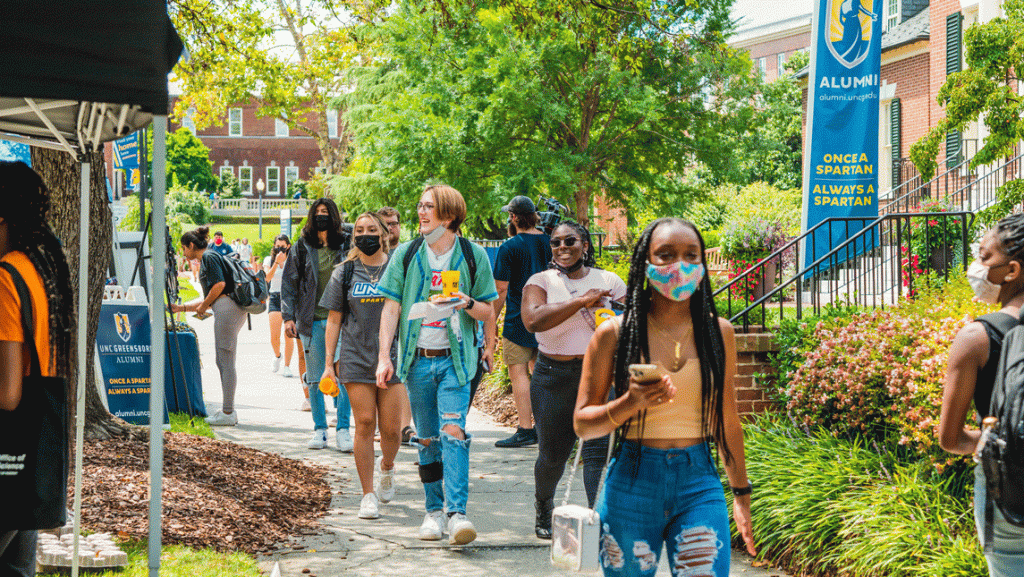
- University of North Carolina at Greensboro (UNCG) — a public research university with more than 18,000 students.
- North Carolina A&T State University (NC A&T) — the largest historically Black university (HBCU) in the United States by enrollment, with over 14,000 students.
- Guilford College — a private liberal arts institution.
- Bennett College — a private historically Black women’s college.
The presence of these institutions has several effects:
- A steady student population supports rental demand.
- Cultural programming (lectures, performances, athletics) is more robust than in many similarly sized cities.
- The job market benefits from a consistent flow of graduates.
NC A&T in particular has become nationally recognized for engineering, agriculture, and STEM programs. UNCG maintains strong programs in business, health sciences, and the arts.
For professionals working in education or research, Greensboro offers institutional stability.
Public School System
Greensboro falls under Guilford County Schools (GCS), one of the largest school districts in North Carolina.
The district includes:
- Traditional public schools
- Magnet programs
- Career and technical academies
- Early and middle college high schools
As with most districts of this size, school performance varies by zone. Families relocating should review specific school assignments rather than relying on overall district averages.
What’s important for relocation decisions:
- Suburban neighborhoods often correlate with higher-rated elementary schools.
- There are magnet options that allow some flexibility.
- Access to dual-enrollment and STEM-focused programs exists.
For families prioritizing education, neighborhood selection is key.
Lifestyle and Daily Living in Greensboro
Greensboro does not feel chaotic. That is often one of the first observations new residents make.
The pace of life is moderate. Commutes are manageable. You can run errands without dedicating half your day to traffic.
Commute and Traffic
According to U.S. Census commuting data, average commute times in Greensboro are generally below the national metropolitan average. Many residents report commute times between 15 and 25 minutes.
This has practical implications:
- Lower fuel costs
- More personal time
- Less daily stress
For remote workers relocating from larger metros, the difference can feel substantial.
Parks and Outdoor Space
Greensboro invests significantly in parks and greenways.
Notable outdoor spaces include:
- The Greensboro Arboretum
- The Bog Garden at Benjamin Park
- Country Park
- Lake Brandt and Lake Higgins recreation areas
These areas support walking, biking, kayaking, and community recreation.
For families and retirees, access to green space adds real quality-of-life value.
Food and Local Culture
Greensboro has a growing local restaurant scene that blends:
- Southern cuisine
- International food options
- Independent coffee shops
- Craft breweries
It is not a nationally recognized culinary hub, but it offers diversity without the pricing pressure seen in larger cities.
What About Nightlife?
Nightlife in Greensboro is present but not overwhelming.
Downtown Greensboro hosts:
- Cocktail lounges
- Live music venues
- Brewery taprooms
- Seasonal street festivals
Because of the university’s presence, there is consistent activity on weekends.
However, it is not comparable to Charlotte or Raleigh in scale. Most nightlife is concentrated in specific areas rather than spread citywide.
For many residents, this balance is ideal — entertainment options exist without constant congestion or noise.
Transportation and Commuting
Greensboro is largely car-dependent.
Public transportation exists through city bus systems, but most residents rely on personal vehicles.
The benefit:
- Shorter commute times compared to major cities.
- Easier parking.
- Less gridlock.
Climate and Weather
Greensboro experiences a humid subtropical climate.
Summers
- Warm to hot, often reaching the 80s and 90s.
- Humidity can be noticeable but not extreme compared to deep Southern states.
Winters
- Mild compared to northern states.
- Occasional light snowfall.
- Rare prolonged freezing periods.
Spring and Fall
- Generally considered the most comfortable seasons.
- Moderate temperatures and visible seasonal changes.
For those relocating from colder climates, Greensboro winters feel significantly milder. For those from extremely hot regions, summers are manageable though humid.
Natural disaster risk is lower than coastal North Carolina regions, as Greensboro is inland and not exposed to direct hurricane landfall, though heavy rains can occur.
Who Greensboro Is Best For
Greensboro tends to work well for:
- Families seeking affordability
- Retirees wanting lower living costs
- Professionals in stable industries
- Individuals relocating from higher-cost states
- Students and young professionals who prefer a slower pace
Who May Struggle Here
Greensboro may not be ideal for:
- Individuals seeking fast-paced urban nightlife
- Those in highly specialized tech sectors
- People reliant on robust public transit
- Individuals expecting large-city salaries
Finally; Is Greensboro a Good Place to Live?
Absolutely!!!
Greensboro is not a “boom city.” It is a balanced city.
Its strength lies in affordability, moderate growth, and livability rather than flash or rapid expansion.
If your priority is financial breathing room, a manageable daily life, and access to community amenities without overwhelming congestion, Greensboro offers real advantages.
If your priority is rapid career acceleration in specialized industries or a high-energy metropolitan culture, larger cities may be a better fit.
Ultimately, Greensboro offers stability — and for many people in today’s economic climate, stability is exactly what they’re looking for.

FAQs
1. What is the quality of life in Greensboro, NC?
Greensboro offers a balanced quality of life with affordable housing, short commute times, access to parks, and a steady job market. It’s less hectic than larger cities like Charlotte or Raleigh, making it appealing for families and retirees. Quality varies by neighborhood, but overall living costs remain moderate compared to national averages.
2. Why would someone want to move to North Carolina?
North Carolina attracts residents because of its lower cost of living, moderate climate, job growth, and no extreme winters. Greensboro, in particular, appeals to people seeking affordability without sacrificing access to education, healthcare, and cultural amenities.
3. What is special about Greensboro, NC?
Greensboro is historically significant as the birthplace of the 1960 sit-in movement and home to multiple major universities. It combines southern charm, educational institutions, and economic stability while remaining more affordable than many U.S. cities of similar size.
4. How much do you need to make to live comfortably in Greensboro, NC?
A single adult earning around $45,000–$55,000 annually can live comfortably in Greensboro, depending on lifestyle and housing choice. A family household typically needs between $75,000–$90,000 combined income for comfortable living without financial strain.
5. Is Greensboro a cheap place to live?
Greensboro is cheaper than many metropolitan areas in the U.S., particularly in housing. While utilities and groceries are near national averages, rent and home prices are generally lower than cities like Charlotte or Atlanta.
6. Is Greensboro safe?
Safety varies by neighborhood. Many residential and suburban areas have low crime rates, while some sections of the city report higher crime rates. Researching specific neighborhoods is essential before relocating.
7. What are the best neighborhoods in Greensboro?
Popular neighborhoods include Irving Park, Lindley Park, Fisher Park, and Northwest Greensboro. The best area depends on your priorities — whether that’s schools, affordability, walkability, or proximity to downtown.
8. What is there to do in Greensboro at night?
Greensboro offers breweries, downtown bars, live music venues, and seasonal events. While not a major nightlife city, it provides steady entertainment options without overwhelming crowds.
9. Is Greensboro good for families?
Yes. Greensboro offers parks, community events, suburban neighborhoods, and access to public and magnet schools. Housing affordability makes it attractive for growing families.
10. Is Greensboro growing?
Yes, but steadily rather than rapidly. The city continues to see gradual population growth and development without the extreme congestion found in larger North Carolina metros.
Connect With Us